
Install the app
How to install the app on iOS
Follow along with the video below to see how to install our site as a web app on your home screen.
Note: This feature may not be available in some browsers.
You are using an out of date browser. It may not display this or other websites correctly.
You should upgrade or use an alternative browser.
You should upgrade or use an alternative browser.
What are you listening to? April 2019
- Thread starter Ojai Sam
- Start date
- Status
- Not open for further replies.


Unsomnambulist
Staff member
Jacques Brel - Quand on n'a que l'amour (1957)


Zeeba Neighba
Staff member
The Isley Brothers - Go For Your Guns (1977)


Old Uncle Toe
Well-Known Member
Various Artists - Jacques Brel Is Alive And Well And Living In Paris Original Off Broadway Cast

The Jacques Brel album was good, but a novelty in my listening routine. I'm trying to listen to this. It's okay but I feel like I'd rather listen to the Isley Brothers. This is like a research project, not background music for the day job.
The Jacques Brel album was good, but a novelty in my listening routine. I'm trying to listen to this. It's okay but I feel like I'd rather listen to the Isley Brothers. This is like a research project, not background music for the day job.

Ojai Sam
Staff member
Freakwater - June 6, 1994 (1995)
Only 1,000 copies of this live album were pressed and sold at Freakwater gigs. This year I got lucky and found a copy in New Zealand. It was worth the wait. Janet Bean and Catherine Irwin turned in a powerful set at the Kulturkeller in Fulda, Germany, including several tunes they never recorded commercially. The sound quality is stunning. Even on my computer speakers, it sounds like they are right here in my office.
 on the Sam-O-Meter.
Only 1,000 copies of this live album were pressed and sold at Freakwater gigs. This year I got lucky and found a copy in New Zealand. It was worth the wait. Janet Bean and Catherine Irwin turned in a powerful set at the Kulturkeller in Fulda, Germany, including several tunes they never recorded commercially. The sound quality is stunning. Even on my computer speakers, it sounds like they are right here in my office.
on the Sam-O-Meter.
Ojai Sam
Staff member
Benny Goodman - Melotone Melodies (rec. 1930-31, Sunbeam comp. 1979)
Vinyl Rip Of The Day.

During the Depression, the major record labels introduced budget lines to stay alive. Melotone was the low-priced series of Brunswick Records, offered at 3 for a buck when the price of a regular 78 was 75 cents. Often the artists appeared under pseudonyms.
The dance band sides assembled in this collection featured such studio heavyweights as Red Nichols, Glenn Miller, Gene Krupa, Eddie Lang, Tommy Dorsey and Sam Shapiro alongside Goodman. Only one more Sunbeam Goodman to go.
Vinyl Rip Of The Day.
During the Depression, the major record labels introduced budget lines to stay alive. Melotone was the low-priced series of Brunswick Records, offered at 3 for a buck when the price of a regular 78 was 75 cents. Often the artists appeared under pseudonyms.
The dance band sides assembled in this collection featured such studio heavyweights as Red Nichols, Glenn Miller, Gene Krupa, Eddie Lang, Tommy Dorsey and Sam Shapiro alongside Goodman. Only one more Sunbeam Goodman to go.
Old Uncle Toe
Well-Known Member
Los Straitjackets - The Utterly Fantastic And Totally Unbelievable Sound Of Los Straitjackets

Los Straitjackets - Viva!

Los Straitjackets - The Velvet Touch Of Los Straitjackets

Los Straitjackets - Supersonic Guitars In 3-D

Los Straitjackets - Viva!
Los Straitjackets - The Velvet Touch Of Los Straitjackets
Los Straitjackets - Supersonic Guitars In 3-D
Ojai Sam
Staff member
Grateful Dead - Blues For Allah (1975, Grateful Dead Label reissue 1987)
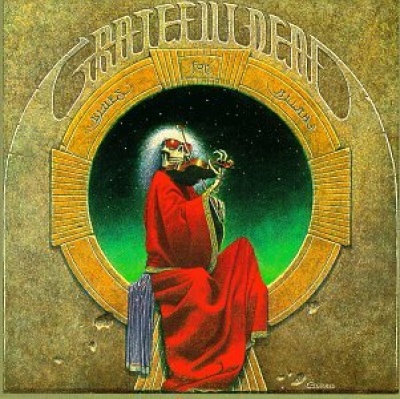
This was the first album reissued when the Dead revived their own record label in 1987, the dawn of the digital era, with good reason. It is one of their finest, most consistent records. AMG sez:
The Grateful Dead went into a state of latent activity in the fall of 1974 that lasted until the spring of the following year when the band reconvened at guitarist/vocalist Bob Weir's Ace Studios to record Blues for Allah. When the LP hit shelves in September of 1975, the Dead were still not back on the road -- although they had played a few gigs throughout San Francisco. Obviously, the time off had done the band worlds of good, as Blues for Allah -- more than any past or future studio album -- captures the Dead at their most natural and inspired.
The opening combo of "Help on the Way," "Slipknot!," and "Franklin's Tower" is a multifaceted suite, owing as much to Miles Davis circa the E.S.P. album as to anything the Grateful Dead had been associated with. "Slipknot!" contains chord changes, progressions, and time signatures which become musical riddles for the band to solve -- which they do in the form of "Franklin's Tower." Another highly evolved piece is the rarely performed "King Solomon's Marbles," an instrumental that spotlights, among other things, Keith Godchaux's tastefully unrestrained Fender Rhodes finger work displaying more than just a tinge of Herbie Hancock inspiration. These more aggressive works contrast the delicate musical and lyrical haiku on "Crazy Fingers" containing some of lyricist Robert Hunter's finest and most beautifully arranged verbal images for the band. Weir's guitar solo in "Sage & Spirit" is based on one of his warm-up fingering exercises. Without a doubt, this is one of Weir's finest moments. The light acoustic melody is tinged with an equally beautiful arrangement. While there is definite merit in Blues for Allah's title suite, the subdued chant-like vocals and meandering melody seems incongruous when compared to the remainder of this thoroughly solid effort.
When they were on their game in concert, the Dead during this time period began to approach the improvisational skill that characterizes jazz. This may be the only studio album that captures the fluid grace of their best live shows.
on the Sam-O-Meter.
This was the first album reissued when the Dead revived their own record label in 1987, the dawn of the digital era, with good reason. It is one of their finest, most consistent records. AMG sez:
The Grateful Dead went into a state of latent activity in the fall of 1974 that lasted until the spring of the following year when the band reconvened at guitarist/vocalist Bob Weir's Ace Studios to record Blues for Allah. When the LP hit shelves in September of 1975, the Dead were still not back on the road -- although they had played a few gigs throughout San Francisco. Obviously, the time off had done the band worlds of good, as Blues for Allah -- more than any past or future studio album -- captures the Dead at their most natural and inspired.
The opening combo of "Help on the Way," "Slipknot!," and "Franklin's Tower" is a multifaceted suite, owing as much to Miles Davis circa the E.S.P. album as to anything the Grateful Dead had been associated with. "Slipknot!" contains chord changes, progressions, and time signatures which become musical riddles for the band to solve -- which they do in the form of "Franklin's Tower." Another highly evolved piece is the rarely performed "King Solomon's Marbles," an instrumental that spotlights, among other things, Keith Godchaux's tastefully unrestrained Fender Rhodes finger work displaying more than just a tinge of Herbie Hancock inspiration. These more aggressive works contrast the delicate musical and lyrical haiku on "Crazy Fingers" containing some of lyricist Robert Hunter's finest and most beautifully arranged verbal images for the band. Weir's guitar solo in "Sage & Spirit" is based on one of his warm-up fingering exercises. Without a doubt, this is one of Weir's finest moments. The light acoustic melody is tinged with an equally beautiful arrangement. While there is definite merit in Blues for Allah's title suite, the subdued chant-like vocals and meandering melody seems incongruous when compared to the remainder of this thoroughly solid effort.
When they were on their game in concert, the Dead during this time period began to approach the improvisational skill that characterizes jazz. This may be the only studio album that captures the fluid grace of their best live shows.
on the Sam-O-Meter.
Unsomnambulist
Staff member
Earthless - From The Ages (2013)

Zeeba Neighba
Staff member
Ween - White Pepper (2000)

Zeeba Neighba
Staff member
Van Halen - Fair Warning (1981)

Unsomnambulist
Staff member
Sly & Robbie/Junior Natural - Militant Dub (2018)

Old Uncle Toe
Well-Known Member
This was a remarkable album and a blast to listen to. It's a shame that after this they never really nailed the studio album again. But it's not like they didn't have a very fruitful career despite that.Grateful Dead - Blues For Allah (1975, Grateful Dead Label reissue 1987)
This was the first album reissued when the Dead revived their own record label in 1987, the dawn of the digital era, with good reason. It is one of their finest, most consistent records. AMG sez:
The Grateful Dead went into a state of latent activity in the fall of 1974 that lasted until the spring of the following year when the band reconvened at guitarist/vocalist Bob Weir's Ace Studios to record Blues for Allah. When the LP hit shelves in September of 1975, the Dead were still not back on the road -- although they had played a few gigs throughout San Francisco. Obviously, the time off had done the band worlds of good, as Blues for Allah -- more than any past or future studio album -- captures the Dead at their most natural and inspired.
The opening combo of "Help on the Way," "Slipknot!," and "Franklin's Tower" is a multifaceted suite, owing as much to Miles Davis circa the E.S.P. album as to anything the Grateful Dead had been associated with. "Slipknot!" contains chord changes, progressions, and time signatures which become musical riddles for the band to solve -- which they do in the form of "Franklin's Tower." Another highly evolved piece is the rarely performed "King Solomon's Marbles," an instrumental that spotlights, among other things, Keith Godchaux's tastefully unrestrained Fender Rhodes finger work displaying more than just a tinge of Herbie Hancock inspiration. These more aggressive works contrast the delicate musical and lyrical haiku on "Crazy Fingers" containing some of lyricist Robert Hunter's finest and most beautifully arranged verbal images for the band. Weir's guitar solo in "Sage & Spirit" is based on one of his warm-up fingering exercises. Without a doubt, this is one of Weir's finest moments. The light acoustic melody is tinged with an equally beautiful arrangement. While there is definite merit in Blues for Allah's title suite, the subdued chant-like vocals and meandering melody seems incongruous when compared to the remainder of this thoroughly solid effort.
When they were on their game in concert, the Dead during this time period began to approach the improvisational skill that characterizes jazz. This may be the only studio album that captures the fluid grace of their best live shows.
Last edited:
Old Uncle Toe
Well-Known Member
Guthrie Trapp - Pick Peace

Jazzy blues guitar, nicely arranged.
Jazzy blues guitar, nicely arranged.
Old Uncle Toe
Well-Known Member
Grateful Dead - Blues For Allah (1975, Grateful Dead Label reissue 1987)
Unsomnambulist
Staff member
Agent Orange - Living In Darkness (1981)

Old Uncle Toe
Well-Known Member
Norah Jones - Begin Again (2019)

I like Norah but this is pretty hit or miss. Granted, the allmusic review noted this is a gathering of experimental tracks. So given that, has she really attained that position where she can gather up any pile of tracks, release it and we'll buy it? She's a good singer, but she's no Linda Ronstadt.
I like Norah but this is pretty hit or miss. Granted, the allmusic review noted this is a gathering of experimental tracks. So given that, has she really attained that position where she can gather up any pile of tracks, release it and we'll buy it? She's a good singer, but she's no Linda Ronstadt.
- Status
- Not open for further replies.
Similar threads

- Replies
- 82
- Views
- 5K

- Replies
- 72
- Views
- 4K
