Heitor Villa-Lobos - Composer, Conductor, Cellist, Cultural Preservationist

Ojai Sam

Staff member
1771696775499.png

Heitor Villa-Lobos (1887-1959) hit my radar twice in the last month, quite by accident. The first time I was looking at the earliest releases on United Artists Records and found Forest of the Amazon, his abortive soundtrack for the film "Green Mansions". I posted that one already and will bring it into this thread. On the second occasion, I was helping a friend complete the Everest Digital Remaster series and learned that a rare piece composed and conducted by Villa-Lobos was the only album not rereleased on CD.

Over his long career, Heitor composed over 2,000 works from piano-vocal duets to symphonies. His proficiency on the guitar, piano and cello illuminated his compositions for those instruments, enabling him to reach the outer limits of difficulty. As a young man he explored the interior of his native Brazil in search of his musical heritage. He even reported (to some skepticism) that he had socialized with cannibals in order to assimilate their dinner music. :nickyboy:

Whether or not that actually happened, Villa-Lobos consistently demonstrated a flair for the dramatic that complemented his often startling compositions and performances. In this thread I will share what I uncover in my more or less random voyage through the recordings of his works. We will also meet author David Appleby, whose name graces the authoritative numbering system for these works. According to (who else for a Brazilian composer?) Amazon, Appleby:

"was born and raised in Brazil and has been studying and performing Villa-Lobos's music for over 50 years. He steers a course through the composer's often contradictory statements about his life and his music, and provides us with a rounded picture of this great figure of the 20th-century music."

Bem-vindo a bordo!

1771699272726.png
 
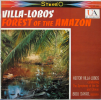
Heitor Villa-Lobos, Bidu Sayao - Forest Of The Amazon (1959)

aka "Floresta do Amazonas"

Appleby No. W551 (composed 1958)

Solo Voice, Male Chorus, piccolo, 2 flutes, 2 oboes, English horn, 2 clarinets, bass clarinet, alto saxophone, soprano saxophone, 2 bassoons, contrabassoon, 4 horns, 4 trumpets, 4 trombones, tuba, timpani, tam-tam, chocalho, triangle, cymbals, reco-reco, pandeira, coconut, bass drum, matraca, tambourine, Indian drum, caixa clara, sleigh bells, small bells, marimba, xylophone, vibraphone, celesta, harp, guitar, sonovox, piano, strings

1771706367288.png


Vinyl Spin of the Day.

Wiki tells us about the unusual provenance of this recording:

His music for the film Green Mansions starring Audrey Hepburn and Anthony Perkins, commissioned by MGM in 1958, earned Villa-Lobos US$25,000, and he conducted the soundtrack recording himself. The film was in production for many years. Originally to be directed by Vincente Minnelli, it was taken over by Hepburn's husband Mel Ferrer. MGM decided to use only part of Villa-Lobos's music in the actual film, turning instead to Bronisław Kaper for the rest of the music. From the score, Villa-Lobos compiled a work for soprano soloist, male chorus, and orchestra, which he titled Forest of the Amazon and recorded it in 1959 in stereo with Brazilian soprano Bidu Sayão, an unidentified male chorus, and the Symphony of the Air for United Artists Records.

United Artists released this album in its classical music series rather than as a soundtrack. The liner notes refer only obliquely to the film, hinting that the composer was unhappy with his involvement in Hollywood but loved his creation. Whatever the case, this is a gorgeous piece of music, jungle exotica without a hint of kitsch. Villa-Lobos wove the rhythms, textures and emotions of his native Brazil into every note. I love the singing of Yma Sumac but have to admit that Bidu Sayao has the better voice, clear and pure. The recording quality is superb, too, like every other UA record I've seen over the years.

Sadly, this landmark recording was never released digitally. The music itself appears only once, on a budget label CD performed by the Moscow Radio Symphony Orchestra. Renee Fleming tries in vain to recreate Sayao's eerie vocals. She may have been the first classical artist ever to sing "The Star-Spangled Banner" at the Super Bowl, but she's no Bidu Sayao, that's for sure.

1771706394804.png
 
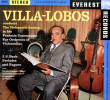
Heitor Villa Lobos Conducts The Violoncello Society (1959)

1772050214552.png
View album 32
Vinyl Rip of the Day.

Fantasia Concertante For Orchestra of Violincellos
Appleby #W549
Composed 1958

If you ever listened to Dr. Demento, doubtless you remember the Temple City Kazoo Orchestra. Villa-Lobos had the same idea decades earlier. According to the liner notes, he composed this unusual piece in Paris over a two week period in Summer 1958 at the request of The Violoncello Society. This group consisted of 32 cellos and the Fantasia is coincidentally scored for "a minimum of 32 cellos." It is a very challenging piece. The composer split the ensemble into five sections, each of which had three different voice parts. One might expect "Row, Row, Row Your Boat" but the complex 15-part mini-symphony sounds a lot like a later Shostakovich string quartet.

The flip side holds Villa-Lobos' striking arrangements of six preludes and fugues from Book 1 of "The Well-Tempered Clavier". Bach would certainly recognize his melodies, but these works offer an enjoyable answer to the question of what Brazilian Baroque music would have sounded like.
 
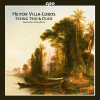
Deutsches Streichtrio - Villa-Lobos: String Trio and Duos (2002)

1773096274647.png

String Trio, W460 (1945)
Duo For Violin & Viola, W463 (1946)
Chôros Bis, For Violin & Cello, W227 (1929)

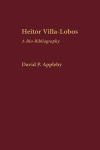
Many composers have their own catalog numbering systems to identify their works. Bach had BWV, Mozart K., etc. The "W" numbers for Villa-Lobos created by David Appleby appeared in his essential "Heitor Villa-Lobos: A Bio-Bibliography" published by Greenwood.

1773096743389.png

Folklorist Douglas Henkel catalogued 99 entries in the "Bio-Bibliography" series here.

This volume packs all the details of Heitor's life and career into 358 pages. As the title suggests, we get a short biography followed by an exhaustive list of "works and performances" (hence the "W" number), discography and bibliography. The W numbers run in chronological order from 1899 (W001) to 1959 (W592). In addition, Appleby catalogues over 200 "collections" of melodies for public education. "Prolific" is an understatement.

CPO Records (or properly, Classic Produktion Osnabrück) has released hundreds of albums bringing to life underappreciated composers with an emphasis on the Romantic Period and the 20th Century. This release by the Deutsches Streichtrio combines the label's usual high caliber performances, sterling sound quality and brief but informative notes.

This post will focus on the two works from the 1940's, reserving comment on "Choros No. 2" for a later date. Villa-Lobos as a master cellist loved to write chamber music but W460 is the only trio in his catalog. It has a distinctly late Romantic flair, reminding me a bit of Brahms. The "Duo", on the other hand, has a contrapuntal form. We have already seen how comfortable Villa-Lobos was in arranging and conducting the works of Johann Sebastian Bach. His ability to work within a purely European idiom reflects the many years he spent on the continent. The Deutsche Streichtrio was the perfect choice to revive this joyous music.

1773098448528.png
 
Back
Top