A new year means it's time for a new Great Record Label here at MG. This time, we're going to Africa by way of Frankfurt.
Year founded: 2006
Founders: Samy Ben Redjeb
Still Active: Yes
Website: www.analogafrica.com
Genres: African
Format: LP, CD, download
Artists: The Green Arrows, Hamad Kalkaba, Hallelujah Chicken Run Band and dozens more
Spotify playlist:
From the Analog Africa website:
For a decade now, Samy Ben Redjeb’s seminal Analog Africa label has been unearthing the best in both explosive foot-shufflers and hypnotic sauntering treasures from Africa. It’s achieved more than most in celebrating the rich and diverse heritage of a much misunderstood and overlooked continent. Samy has spared nothing in his pursuit of choosing authentic and eye-opening choice records. His lifestyle and string of various jobs—from a Life Aquatic sojourn as a diving instructor in Senegal to a stint as a Lufthansa flight attendant crisscrossing the Lagos-Addis Ababa-Accra arc and beyond—have all been centered on a passion for crate digging.
More details of Samy's fascinating musical journey here:
The Green Arrows - 4-Track Recording Session (rec. 1974-1979, comp. 2007)
Tracks 1 to 10; Part One (1974-75) Chipo Chiroorwa LP.
Track 11 to 20; Part Two (1976-79) Waka Waka Selection.
All tracks originally recorded and released in Zimbabwe.
Analog Africa sez:
Undoubtedly the most important musical act to emerge from Zimbabwe in the 1970s, the Green Arrows transmuted the widespread social upheaval of their homeland into hopeful, rhythmic, political, experimental music. This extraordinarily progressive group took the country by storm, fusing the different rhythms of the region into one unique and ebullient sound. The Green Arrows were the first Zimbabwean band to record an LP (released in February 1976) - a milestone in Zimbabwean music history. Also their song 'Musango Mune Hangaiwa' still holds the record for the longest stay at number1 in the Zimbabwean charts (4 months).
At the start of the 1970s the Green Arrows were merely the best bar band in all of Zimbabwe. By decade's end, they had achieved a level of fame previously unheard of in the country. The band's mercurial bassist and lead singer, Zexie Manatsa, became the patriarch of a flourishing musical scene in Zimbabwe, then Rhodesia. When he got married in 1979, an estimated 60,000 guests showed up for the wedding, held in Rufaro Stadium in Harare, with Oliver Mtukudzi and Thomas Mapfumo amongst the performers.
The Green Arrows, discovered by South African producer West Nkosi, had become the tightest, funkiest band around. The music was branded ‘wha wha (= beer) music’ as it got people to consume vast amounts of beer.
The Arrows’ unique sound managed to be intensely danceable and catchy, yet breezy and laid-back at the same time. Guitar riffs sparkle like stars throughout each of these three-minute-long compositions. The rhythm section is flawless and the mellow, stoned vocals perfectly convey the band's overarching message: ‘Forget your troubles for a little while and dance with your fellow human beings - something great might come of it’. This is music to get lost inside, hypnotic and gently percussive, utterly irresistible and addictive.
The twenty tracks on this CD, collected here by Analog Africa’s Samy Ben Redjeb and all painstakingly re-mastered, vividly illustrate the Arrows' rise to greatness. Divided into two parts, the first of which is culled from the Chipo Chiroorwa LP (1974) and features material from 1974 and 1975, and the second of which, called Waka Waka Selection combines singles recorded between 1976 and 1979.
Bass, Lead Vocals - Zexie Manatsa
Lead Guitar - Stanley Manatsa
Rhythm Guitar - Fulton Chikwati
Bass, Rhythm Guitar - Givas Bernard
Drums - Raphael Mboweni
Guest Vocals - Wilfred Nyomi
The Hallelujah Chicken Run Band - Take One (rec. 1974-1979, comp. 2007)
We return again to Zimbabwe for this one. Analog Africa sez:
The Hallelujah Chicken Run Band (or HCR for short) was one of the seminal bands that formed the explosive Zimbabwean music scene in the 1970s and one of the first acts to develop the staccato style of guitar playing for which Zimbabwe is known today, a 'breathless, loopy, dampened plucking that mimics traditional mbira thumb-piano melodies' (Rolling Stone). Upbeat, vibrant and catchy, as well as beautiful and emotional, their music can now be explored on the compilation 'Take One (1974-79)', to be released on 8 October by the Analog Africa label whose previous release was by The Green Arrows.
'Take One' presents 18 of HCR's biggest hits (including a series of singles for which the band received eight gold records in 1974), as well as rare songs, all recorded between 1974 and 1979. The CD has been compiled from vinyl records and the original master tapes found in Zimbabwe, all painstakingly remastered.
During HCR's most active years Rhodesia, as Zimbabwe was called then, was between its British colonial past and full independence. HCR was one of the first modern groups to sing in the Shona language - which most of the White minority government could not understand – this in itself was a major act of liberation and protest against the Rhodesian government. Alongside the occasional love song the compilation, political songs and songs of liberation prevail.
The collection features a handful of appearances by Thomas Mapfumo, one of Zimbabwe's biggest and most influential artists, on drums and vocals. Whilst playing with HCR Mapfumo began to explore the traditional music of his Shona people and adapted this to modern rock instrumentation, transcribing the scale of the mbira (or thumb piano) to electric guitar with HCR guitarist Joshua Hlomayi Dube.
In the Seventies many home-grown African pop bands were funded by their respective culture ministries; HCR though was funded by the white owners of the Mangura Copper Mine. The owners believed that the mine workers, many of them from neighbouring Malawi, would benefit from some musical entertainment after long shifts. Trumpet player Daram Karanga was hired in 1974 to assemble the group. Two members of the group at the time found day jobs working at a local chicken farm (chicken run). Upon hearing this, the mine's boss shouted 'Hallelujah!' - and then proceeded to christen the band with the name Hallelujah Chicken Run Band.
When the group first started performing at the mine they played a lot of rumba, cha cha cha and soul covers. Whilst the white management liked this, it didn't prove popular with the mine workers. Instead it was the traditional 'Zim style' songs made them go crazy and this was the direction they then went into. The band's popularity quickly grew, and they were asked to perform at many different events throughout the country. In 1974, HCR won the first national music contest held in Harare for the Teal company. There they were also discovered by legendary producer Crispen Matema with whom they later recorded a well-known studio session, from which many of the tracks on this collection are drawn.
Raw & Psychedelic Afro Sounds from Benin & Togo 70s
'African Scream Contest' is the third release by the Analog Africa label. The project initially took off in August 2005 when label owner and vinyl collector Samy Ben Redjeb arrived in Cotonou, Benin, 'without any special expectations, just hoping to lay my hands on few good records - what I found in the process cannot really be described in words'. This first trip was followed by eight more to the region. Thirty months and few thousand records later Analog Africa proudly presents this 14-track compilation.
Just like with the label's first two releases - albums by Zimbabwean 70s bands the Green Arrows and Hallelujah Chicken Run Band - the essence of Analog Africa is clear yet again: searching in dusty warehouses for forgotten music to keep it alive. Ben Redjeb explains: 'Some of the track we've already released would have been lost for ever if we didn't do it. With 'African Scream Contest' this is even more the case as some of the bands and musicians were, and still are, completely unknown. Some of the tracks have not even been released and I found a lost master tape at the producer's house who decided not to release it and just left it aside.' (The compilation contains a track by Vincent Ahehehinnou & Poly-Rythmo which wasn't even released in Benin.)
Recording more than 50 albums and hundreds of 45s, Orchestre Poly-Rythmo were one of the most prolific bands of the 20th century. They were also one of the best. An innovative group that developed its own distinctive style of hard-driving funk but still found time to record in just about every style imaginable, from highlife, Afrobeat, and rumba to rock, jazz, soul, and folk. And yet, as of today, they don't even have a Wikipedia page. That peers of Bembeya Jazz National, Orchestra Baobab, Rail Band, OK Jazz, Fela's Africa 70, and every other great African band of the 1950s-70s has managed to remain this obscure and unheard is frankly baffling-- and attributable more to the capricious nature of fame than any other single factor.
The band's geographic location probably didn't help. Their home country of Benin, a relatively small nation bordering Nigeria, is often overshadowed in the eyes of the rest of the world by its neighbors, and because the former French colony and its even smaller neighbor Togo are surrounded by the Anglophone giants Ghana and Nigeria, their recordings sometimes found it difficult to travel far outside their borders. (Though they did tour much of Africa and even France during their 1969-1982 heyday.) Still, Poly-Rythmo and its most prominent members are household names in their homeland.
Compiled by Analog Africa's Samy Ben Redjeb, The Vodoun Effect gathers 14 of the band's rawest, funkiest cuts into a thrilling hours-plus album. The generous, 44-page liner notes inform us that while the band did most of its recording, and certainly its most prominent recording, for the Albarika Store label, it also cut dozens of sides for smaller labels of more modest means. This compilation focuses on those releases. Many of these tracks were recorded with a microphone or two plugged into a Nagra reel-to-reel machine, but you'd never guess the setup was that simple from the incredible depth and fidelity of the sound. Pressings of these 45s rarely exceeded 500 copies, and distribution scarcely ever reached outside the coastal cities of Cotonou and Porto Novo, so this is the first any of these songs save one have ever been available outside Benin.
Let's start the new month with a double helping of African rhythm!
BBC Music sez:
Legends Of Benin comprised of fast-paced Afro Latin funk rhythms has been carefully selected by Ben Redjeb. Spanning four genres and three decades, the album highlights the work of four of Benin's great musicians: Gnonnas Pedro, Antoine Dougbe, El Rego and Honoré Avolonto. Each adds a unique vibrancy to the album, contrasting with and complimenting each other.
Traditional rhythms form the base of many of the tracks, Gnonnas Pedro's Abadja Rhythms underscore Okpo Videa Bassouo, while Antoine Dougbe's music combines Vodoun and Congolese rhythms in the 'Afro Cavacha' style he pioneered. His track Ya Mi Ton Gbo is one of the funkiest tracks here. Legendary percussionist and composer Honoré Avolonto offers some of the grittiest music on the album. His style, similar in parts to Fela Kuti, is enormously energetic.
The album leaps from Afro-funk to Afrobeat to Soul to Cavacha seamlessly. This variety has a lot to do with when the music was recorded: the 70s was a politically turbulent decade for Benin, reflected in the raw unrelenting beats.
Legends Of Benin is praiseworthy for contextualizing Benin's contribution to Afrobeat and African music as a whole.
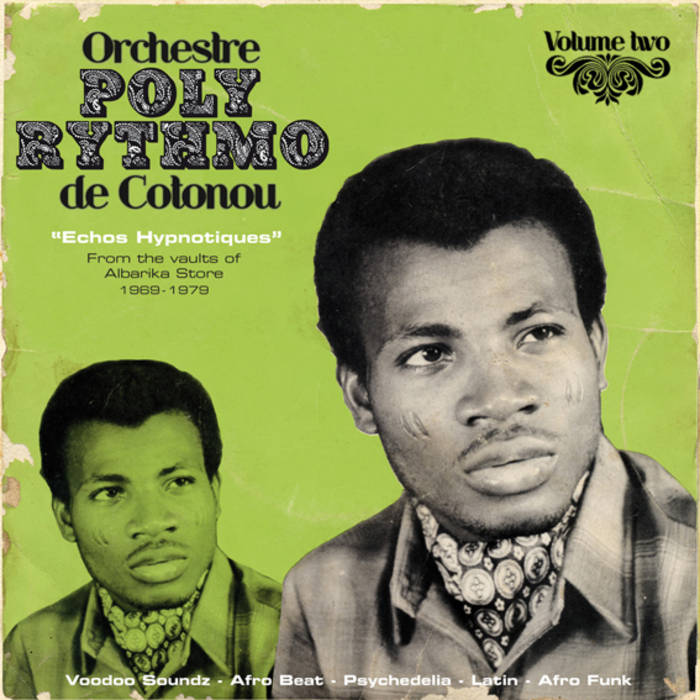
Orchestre Poly-Rythmo de Cotonou - Vol. 2: Echos Hypnotiques (2009)
Bandcamp sez:
Four years in the making, Analog Africa finally presents the second volume of Africa's funkiest band, the mythical Orchestre Poly-Rythmo de Cotonou. Volume One (The Vodoun Effect - Funk & Sato from Benin's Obscure Labels, 1973 - 1975), released by Analog Africa at the end of 2008, was a collection of amazing lo-fi recordings produced for various labels around Benin. Volume Two showcases superbly recorded tracks, courtesy of the EMI studios in Lagos, Nigeria, one of the best studios in the region. All tracks here were recorded for the mighty Albarika Store label and its enigmatic producer, Adissa Seidou.
This is some of the most exciting South American music I've ever heard. The complex pulsating rhythms, owing as much to Africa as to Colombia, will drive you to the brink of madness.
AMG sez:
The opener to this set, "Carruseles," begins with some piano that's straight out of Little Richard, before a brief pause, then the band blazes into some serious Latin music. But that's the spirit of Anibal Velasquez and his band -- they attacked what they did in the spirit of rock & roll. It doesn't matter whether it's a cumbia, a guaracha, or whatever, this is simply rock through a different musical prism, and every bit as stirring as Chuck Berry. "Que Paso" and "Santo Amor" both take Colombian sounds to places they'd never been before, and even when Velasquez gets rootsy, as on "Cumbia Bogotana," it's very much on his own terms. The nearest analogy is with the punks who upended rock, or even the very first generation of rockers, who subverted the forms and split everything wide open. This is high-octane music, a sound revelation that's absolutely invigorating and convincing.