Great Record Labels: Capitol Records

Ojai Sam

Staff member
Various Artists - Songs By Johnny Mercer (Capitol A-1, 1944)

MjQtMTY1MC5qcGVn.jpeg


That's right, this was the very first album released on the label which is still in business today. As Wiki tells us:

Songwriter Johnny Mercer founded Capitol Records in 1942 with financial help from songwriter and film producer Buddy DeSylva and the business acumen of Glenn Wallichs, owner of Wallichs Music City. Mercer raised the idea of starting a record company while golfing with Harold Arlen and Bobby Sherwood and with Wallichs at Wallichs's record store. On February 2, 1942, Mercer and Wallichs met DeSylva at a restaurant in Hollywood to talk about investment by Paramount Pictures.

1693261110881.png
 
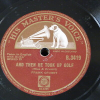
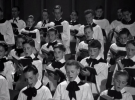
The St. Luke's Choristers - Christmas Carols (Capitol A-2, 1944)

MS02MDMzLmpwZWc.jpeg


Mrs. Ojai is already working out the Christmas menu so I guess it's not too early to audition some seasonal music. The second album released on Capitol must have sold pretty well, since it made the leap from a booklet of four 78 RPM singles to a box of four 45 RPM singles to a ten inch 33 RPM album.

OC01OTU4LmpwZWc.jpeg

78 RPM

OS00MzAxLmpwZWc.jpeg


My00MTUyLmpwZWc.jpeg

45 RPM

Mi00MTM0LmpwZWc.jpeg

10" LP

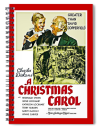
The group, based in Long Beach, California, appeared in over 75 films including the 1938 version of "A Christmas Carol."

1693335414634.png
1693335538794.png
 
The Capitol Jazzmen - New American Jazz (Capitol A-3, 1944)

Ni0xODYzLmpwZWc.jpeg


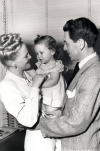
For its third album release, Capitol put together two sessions featuring small groups of outstanding jazz musicians based in Hollywood. The vocals of 23 year old Peggy Lee accompanied by the guitar of future ex-husband Dave Barbour are a real highlight.

1693435419321.png

Peggy, Nicki and Dave
 
The Dinning Sisters - Songs By The Dinning Sisters (Capitol A-7, 1945)

Ni0zMTc4LmpwZWc.jpeg


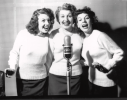
The Dinning Sisters were Capitol's answer to The Andrews Sisters. The Oklahoma bred trio originally consisted of "Lou" (Ella Louise), "Jean" (Eugenia) and "Ginger" (Virginia). Being ten years younger than the Andrewses, the Dinnings came across as a bit perkier but far less extroverted than Decca's brassy trio. They stuck around until 1955 with some personnel changes but chart success largely eluded them. Jean went on to co-write "Teen Angel" for brother Mark Dinning. The original trio reunited during the nostalgia boom of the 1980's.

1693518528659.png
 
Harry Owens & His Royal Hawaiians - Hawaii (Capitol A-4, 1944)

OS02Nzc3LmpwZWc.jpeg


Vinyl Rip Of The Day.

Starting a new record label is a bit like drafting an expansion sports team. You're going to begin life with a bunch of old has beens, young wannabes and maybe some question marks in between. Capitol Records opened the doors with some of each. Yesterday we met The Dinning Sisters at the dawn of their career. Today's album comes from music veteran Harry Owens, who had been recording since at least 1929.

Harry (1902-1986) started in vaudeville at age 14 as a cornet player and formed his first band in 1926. However, he didn't find success until 1934 when he became music director at the Royal Hawaiian Hotel in Waikiki. Wiki explains that

"[Owens] learned many traditional and more modern Hawaiian songs and tunes which he wrote down and orchestrated using Western notation for the first time. Many had never been written down before, much less orchestrated. He reorganized the Royal Hawaiians by splitting the band into Hawaiian and haole instrumental sections. His band featured the steel guitar, which had a trademark sound, producing tuneful and rhythmic dance music with a strong Hawaiian flavor."

Today one might call that cultural appropriation but there's no doubt that songs like his massive hit "Sweet Leilani" (popularized by Bing Crosby) helped fuel interest in Hawaii that exploded after WWII. Harry had been recording Hawaiian music for Decca, Bing's label, for several years when he landed at Capitol. This album features eight tunes is Harry's popular crossover orchestral style, including "Sweet Leilani". It must have sold well, because Capitol released a second collection almost immediately. Moreover, it has remained in print to this day as a 45 RPM album, 10" LP (from which my rip came) and recently as a CD from Bear Family.

1693592103196.png

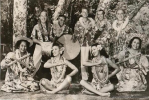
That's Harry in the top row with the glasses.
 
Dennis Day - Dennis Day Sings! (Capitol A-5, 1945)

NC03OTYzLmpwZWc.jpeg


Vinyl Rip of the Day.

Dennis Day (born Owen Patrick Eugene McNulty) is best known for his long tenure on the Jack Benny radio and television shows. He played a naive, rather bewildered young tenor with a mild personality and a big voice. This schtick was later borrowed by Frank Fontaine and Jim Nabors. Like Crazy Guggenheim and Gomer Pyle, the comic persona of Dennis Day didn't come across in his recordings, making them rather ordinary. Despite having been on Benny's show for five years, these 1944 sides for Capitol were his first sessions. They do illustrate what a fine voice Day had, with his green roots showing on "Danny Boy". Dennis married Peggy Almquist, Ann Blyth's sister, with whom he had 10 children.

1693764582358.png
 
Dennis Day - Dennis Day Sings! (Capitol A-5 1945)

NC03OTYzLmpwZWc.jpeg


Vinyl Rip of the Day.

Dennis Day (born Owen Patrick Eugene McNulty) is best known for his long tenure on the Jack Benny radio and television shows. He played a naive, rather bewildered young tenor with a mild personality and a big voice. This schtick was later borrowed by Frank Fontaine and Jim Nabors. Like Crazy Guggenheim and Gomer Pyle, the comic persona of Dennis Day didn't come across in his recordings, making them rather ordinary. Despite having been on Benny's show for five years, these 1944 sides for Capitol were his first sessions. They do illustrate what a fine voice Day had, with his green roots showing on "Danny Boy". Dennis married Peggy Almquist, Ann Blyth's sister, with whom he had 10 children.

View attachment 10189
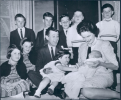
She looks tired.
 
Dennis Day - Dennis Day Sings! (Capitol A-5 1945)

NC03OTYzLmpwZWc.jpeg


Vinyl Rip of the Day.

Dennis Day (born Owen Patrick Eugene McNulty) is best known for his long tenure on the Jack Benny radio and television shows. He played a naive, rather bewildered young tenor with a mild personality and a big voice. This schtick was later borrowed by Frank Fontaine and Jim Nabors. Like Crazy Guggenheim and Gomer Pyle, the comic persona of Dennis Day didn't come across in his recordings, making them rather ordinary. Despite having been on Benny's show for five years, these 1944 sides for Capitol were his first sessions. They do illustrate what a fine voice Day had, with his green roots showing on "Danny Boy". Dennis married Peggy Almquist, Ann Blyth's sister, with whom he had 10 children.

View attachment 10189
Confused him with Dennis O'Dell at first. Oops.
 
By the way, was Dennis Day related to the Mouseketeer Dennis Day?
According to The Original Mickey Mouse Club Show website, no.

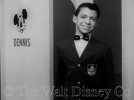
"Dennis Wayne Day was born in Las Vegas, Nevada, on July 12, 1942. His family had no show business background, and Dennis is not related to the famous singer who used a similar stage name. Dennis had three sisters Nelda, Kathy, and Shirley. His father, Fred A. Day, was a golf course superintendent and his mother, Verda L. Day, was an office manager.

Dennis began his show business career at age six. Before auditioning for the MMC, Dennis worked in television, commercials, educational films, and appeared in the James Cagney film A Lion Is In The Streets (1953). Dennis auditioned for the MMC with his sister Nelda. They did a dance routine that fell apart midway due to the piano players' mistake. Dennis stopped the routine, and worked with pianist to get the performance back on track. His poise and command of the situation impressed the casting panel and Dennis was hired immediately."


1693859933386.png

What a sad story. :(
 
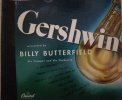
Billy Butterfield - Gershwin (Capitol BD-10, 1945)

front.jpg

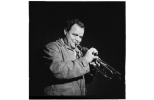
Trumpeter Billy Butterfield was best known as a sideman in the big bands of Bob Crosby, Tommy Dorsey, Artie Shaw, Les Brown and Benny Goodman. However, he did lead his own criminally underrecorded big band from 1943 to 1947. His clear, powerful yet smoothly controlled tone added to every recording he appeared on. This collection from Capitol gathers his big band sides from three different sessions with an array of vocalists including label owner Johnny Mercer and a very young Margaret Whiting. The classic material is perfectly suited to Butterfield and his swinging ensemble.

1694310468495.png
 
Last edited:
Harry Owens & His Royal Hawaiians - Songs Of Hawaii (Capitol A-6, 1944)

MzQtNzQ0Ni5qcGVn.jpeg


Harry's second Capitol album contains more faux tropical novelties than his first. Songs like "The Hula Rhumba" and "Eat Poi, My Boy (It Will Make A Man Of You)" may not be to everyone's taste, but after a couple of my patented mai tais (complete with paper parasol), they all sound great.

1694375368635.png
 
Back
Top