Great Record Labels: Capitol Records

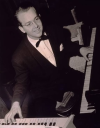
Buddy Cole - Piano Cocktails (Capitol BD-24, 1946)

Ny02NTAyLmpwZWc.jpeg


This album may be the prototype for the whole "cocktail jazz" genre. Buddy Cole (1916-1964) started his career at age 10 accompanying silent films. He worked his way up from big band sideman to Bing Crosby's long time accompanist and then to session work. A versatile musician, Buddy could handle piano, organ and celeste with aplomb. This album feature 8 unbeatable show tunes from the likes of Cole Porter and Jerome Kern in piano trio format. Buddy's playing is subtle but never soporific, just enough to hold your interest without making you spill your sidecar.
1695767859039.png
 
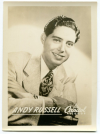
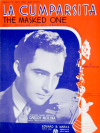
Andy Russell - Favoritos (Capitol BD-13, 1945)

My03ODExLm1wbw.jpeg


Shellac Rip of the Day.

The observant among you may have noticed that we skipped catalog number 13 on our march through the early Capitol albums. I was waiting for this original album to arrive here in Ojai by Pony Express. :cheer:

Andy Russell (1919-1992) was both a unique artist and a cultural phenomenon. Born Andrés Rábago in the Boyle Heights neighborhood of Los Angeles, Andres began his career in music at a young age. When he was 16, he dropped out of high school to join the orchestra of Gus Arnheim playing at the upscale Coconut Grove. Gus had an eye for young talent, having played a part in launching the career of Bing Crosby among others. He wound up as Andrés' guardian and persuaded him to change his name to "Andy Russell". Arnheim also came up with the idea of having "Andy" sing in both English and Spanish, to the delight of the society crowd at the Ambassador Hotel.

Andy signed to Capitol in 1944, releasing this album a year later after a number of successful singles. He sings some of the songs here in English, some in Spanish and some in both in a smooth baritone not unlike Frank Sinatra. The album title and cover art speak for themselves. If this all sounds like Capitol was flailing around trying to figure out Andy's market, the liner notes reinforce that conclusion. They breathlessly proclaim him to be "a handsome young American, born and reared in Los Angeles, with a deep insight into the music of Latin-America...." Why was the label so emphatic? Perhaps because the Zoot Suit Riots of 1943 had highlighted the racial tensions in the City of Angels. Later we will explore how Capitol made similar efforts to bring Nat King Cole into the mainstream.

Andy would move to Mexico in 1954 after a traumatic divorce, where he would become an international star. Twelve years later, he would return to the U.S. and to Capitol where he recorded country music in the smooth Nashville Sound style.

Andy's life would make for a fascinating biography. In the meantime, we can enjoy his fine musical efforts on their own terms.

1695842055603.png
 
Carlos Molina - Rhumba (Capitol BD-25, 1946)

OS05MjY0LmpwZWc.jpeg


The 20th Century saw a series of dance crazes sweep the United States. The cakewalk, the fox trot, the Charleston, all had their time. The rhumba caught on in the early 1930's, so this album by Colombia's Carlos Molina "and his Music of the Americas" was a bit retro when it came out. The liner notes acknowledge that he and his violin had found success ten years earlier, leading to appearances in films with the likes of Joan Crawford and Greta Garbo. Molina's brassy big band followed in the footsteps of Xavier Cugat, Vincent Lopez and their ilk with colorful instrumentals and energetic vocals by Bobby Rivera, Mano Lopez and the enigmatic "Lydia".

1695934853412.png

After 25 releases, Capitol had already built a diverse catalog with appeal to many tastes. A rough count breaks down like this:

Jazz - 5
Popular Vocal - 4
Popular Instrumental - 4
Children - 4
International - 4
Sacred - 2
Light Classical - 2

To be honest, I've enjoyed this listening project a lot more than I expected, so let's continue our journey tomorrow with an artist who was no stranger to the road.
 
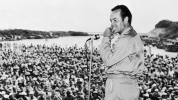
Bob Hope - "I Never Left Home" (Capitol CD-26, 1946)

NS0xNzg1LmpwZWc.jpeg


Despite his many years at the top of the entertainment world, Bob Hope never enjoyed much success with recordings. He recorded a couple of one off duet singles for Decca with Shirley Ross in the late 30's (including "Thanks For The Memory"). In 1944 he released another Decca single with Bing Crosby featuring "Road To Morocco". But this album for Capitol shows him at his best, performing standup comedy for highly receptive audiences of young service men at their training camps in 1945. The Army (at Camp Roberts CA, where my uncle trained), Navy (Great Lakes Naval Station, Chicago), Marine Corps (Camp Pendleton CA) and Coast Guard (Pearl Harbor) all come in for rapid fire topical humor. Due to the time limitations of 78 rpm discs, we get only a 5 minute highlight from each live show.

With this album, Capitol added comedy to its growing catalog. Until someone proves me wrong, I'm going to go out on a limb and call this the first comedy album in history. Oh, there were plenty of humorous singles dating back to the late 19th century, but comedy albums didn't begin to appear until the 50's. Hope himself would only record a couple more albums, concentrating his energies on film, TV and personal appearances.

1696018744626.png
 
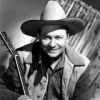
Tex Ritter - Cowboy Favorites (Capitol BD-27, 1946)

NC0yNDEyLmpwZWc.jpeg


We met Tex a while ago with a children's album. John Ritter's dad returns with this collection of tunes sharing a vaguely western flavor. They were all recorded at sessions in the spring of 1945 with a full band, including Capitol studio stalwarts Merle Travis, Wesley Tuttle and Cliffie Stone. None of these songs were hits but all are enjoyable, especially Tex's over-the-top reading of "Blood On The Saddle" which would make a hemophobe of anyone.

1696109446350.png
 
Original Broadway Cast - St. Louis Woman (Capitol CE-28, 1946)

Ny03MjE0LmpwZWc.jpeg


Three years after Oklahoma!, the first authentic Broadway cast album on Decca, Capitol released St. Louis Woman. Label owner Johnny Mercer contributed the lyrics to accompany Harold Arlen's music for this adaptation of Arna Bontemps' novel "God Sends Sunday". The all Black cast included luminaries like Pearl Bailey and the Nicholas Brothers. Unfortunately the writing fell short, incurring the displeasure of the NAACP for the stereotypical characters. It was bad enough that Lena Horne walked away from the project, to be replaced by Bailey. Even a standout song like "Come Rain Or Come Shine" couldn't save the show, which lasted just 113 performances. Capitol would go on to release many more Broadway musicals in the future before abandoning the field to Columbia and RCA Victor.

1696372567316.png
 
^
Yesterday

Today:

Nat King Cole - King Cole Trio Vol. 2 (Capitol BD-29, 1946)

MC04OTYxLmpwZWc.jpeg


For Cole's second album, Capitol stuck with the smooth ballads and instrumentals that were bringing him increasing success. At a time when jazz was being transformed by bebop and honking saxes, Nat was still an impeccable jazz player and the trio format gave him plenty of room to work out.
 
Frank De Vol - Memory Waltzes (Capitol BD-31, 1947)

OTEtNDIxMS5qcGVn.jpeg


#30 isn't over at the Internet Archive, so let's move on while I wait for the copy I ordered to arrive.

Frank De Vol (1911-1999) is a familiar name to anyone like me who is an inveterate reader of TV credits. "My Three Sons", "Family Affair", "The Brady Bunch" and many other shows benefited from his catchy themes. Frank also appeared regularly as actor on shows like "Get Smart!" and, yes, "My Three Sons". To avoid confusion, he preferred to be known as "Frank De Vol" on acting jobs and "De Vol" as a composer.

This album offers truth-in-labeling at its best: "Symphonic Arrangements Of Famous American Waltzes" indeed. Pretty tame stuff. Tomorrow we will get an encore appearance from an artist who teaches us how to grin and bear it.

1696464949060.png

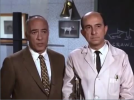
Frank De Vol (right) as "Professor Carleton" on "Get Smart!"
 
I've been listing the full catalog number for each Capitol album, starting with (where else?) "A-1". But what do those numbers really mean:?

According to Tim Neely's post over at the Steve Hoffman Music Forums:

"Capitol's album series started with album A-1, released in May 1944 (and later reissued as CD-1). Capitol's first eight albums had "A" prefixes when originally released.

IMG_5534.jpg

Starting in 1945, Capitol changed its album code to a two-letter prefix. The first letter indicated the series in which an album was released (“B” albums had individual records in the 20000 series; “C” albums, probably short for Criterion as they originally had “Capitol Criterion” labels, had individual discs in the 10000 series). The second letter indicated the number of records in the set (A=1, B=2, C=3, D=4 and so on). The first new album with this kind of prefix was BD-9, Music for Dreaming by Paul Weston and His Orchestra."
 
Margaret O'Brien - Goldilocks and the Three Bears (Capitol CB-32, 1946)

NjUtNTMwMy5qcGVn.jpeg


Margaret returns with a dramatic interpretation of the folk tale that restored porridge to the menu in homes everywhere.

1696721914391.png
Science aside, Margaret's second album is a significant improvement over her first. Rather than just read the story, she performs the fast moving script with the aid of some very talented but uncredited voice actors. The sound effects and "incidental music" are outstanding. When you stop to think that radio was the highest form of home entertainment at the time, children's records like this offered comparable quality to the wee folks. Post-war moms and dads were a ready market for anything that provided an effortless response to those never ending requests to "tell me a story!"

:5.0: on the Sam-O-Meter. Watch for the R-rated version where Goldilocks asks Papa Bear, "so what's ursine, big boy?"
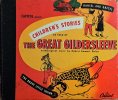
 
Harold Peary - Children's Stories As Told By The Great Gildersleeve (Capitol CD-33, 1946)

front.jpg

Some creative genius at Capitol decided that Peary's follow up to Stories For Children should be titled Children's Stories. :rolleyes: I haven't dared to see if there is a third volume.
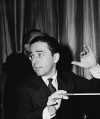
Peary is a good storyteller but the highlight here is Robert Emmett Dolan's music. Dolan was a highly versatile artist whose roles included pianist, composer and conductor. He migrated from Broadway to Hollywood, where he became music director for MGM and then Paramount. These story records feature a full orchestra with elaborate arrangements. As with the last album by Margaret O'Brien, Capitol spared no expense here to bring topnotch entertainment to a juvenile audience.

1696799763938.png

Robert E. Dolan at work.
 
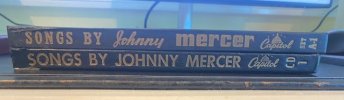
Johnny Mercer & The Pied Pipers - s/t (Capitol CD-36, 1946)

Ny00Njg0LmpwZWc.jpeg


34 and 35 are on order, so let's move on to this winning combination. In addition to being a first class songwriter, Johnny Mercer was an excellent singer of both ballads and jazz, not to mention having a keen eye for talent. He signed The Pied Pipers vocal group to his label after they had a blowup with Tommy Dorsey for whom they had been backing Frank Sinatra. We will hear more of their story later in this series, but here they step out both with and without Mercer. These 8 superb songs are arranged with a strong jazz inflection by Paul Weston (who not so coincidentally had also toiled for Tommy D). As a result, this album is a highly entertaining illustration of the post-war rise of the featured vocalist to eclipse the big bands with their largely anonymous singers.
 
Paul Weston - Music For Memories (Capitol BD-37, 1946)

MS0xMzY2LmpwZWc.jpeg


The album title is perhaps more honest than Capitol intended, since this one is very reminiscent of Weston's first outing, Music For Dreaming (#BD-9) from the previous year. String-laden orchestral versions of 8 mostly familiar standards show Weston's ability with smooth arrangements. As with the earlier album, Music For Memories persevered in the Capitol catalog from the 78 era all the way to digital downloads.
 
Lois Butler - Victor Herbert Sung By Louis Butler (Capitol BD-30, 1946)

Ni04NDIyLmpwZWc.jpeg


Shellac Rip Of The Day.

Buying 78's is always an adventure, even when they come in their original cardboard album. I bought this from an experienced seller who packaged it securely. Nevertheless, each disk had a small crack running all the way across. With some trepidation, I placed them gently on my turntable and somehow managed to get decent rips of all eight sides. :worm:

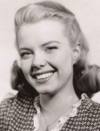
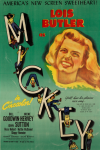
Lois Butler (1931-1989) was a child prodigy. She recorded this album at age 14 and went onto modest success in radio and film, making three features between 1948 and 1950. For the first of her two Capitol albums, she reached back to the operettas of Victor Herbert. Her clear soprano voice was perfectly suited to this light romantic material from the turn of the century. Paul Weston, a busy guy at the Capitol studios, provided tasteful orchestral backgrounds that frame Butler's exquisite voice.

1697050805774.png


1697050844165.png
 
Diana Lynn - Piano Portraits (Capitol CC-38, 1947)

OC0yNDAwLmpwZWc.jpeg


A few posts back, I compared starting a new record company with organizing an expansion baseball team. Before free agency, new teams became successful by investing in the minor leagues as a pipeline for future stars. Capitol was able to use the radio and film industry in its Hollywood home base for the same purpose.

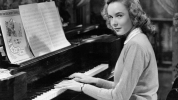
Today, we meet Diana Lynn (1926-1971) whose career arc was very similar to that of yesterday's artist, Lois Butler. Starting as a piano prodigy performing publicly at age 6, Diana parleyed her talent into a modest film career than ran into the 1950's.

lf.jpg

This album shows Lynn to be an excellent pianist, leaning heavily on the adaptations of classical pieces for the pop market that were all the rage at the time. Would you be surprised to hear that Paul Weston contributed the orchestrations here? Diana would release only one more album for Capitol in 1950.

1697150346948.png
 
Stan Kenton - Artistry In Rhythm (Capitol BD-39, 1946)

MC5qcGVn.jpeg


Stan Kenton signed with Capitol Records in 1943 and stayed with the label through the early 70's. Artistry In Rhythm was his first Capitol album but oddly enough, it didn't include the title song. The ones it does contain showcase the increasingly adventurous direction Stan was taking. Pete Rugolo's bold arrangements and June Christy's cool vocals pushed the music far beyond the stylistic straitjacket imposed by the big band era. This album is as hot as its cover art, a real eye opener then and now.
 
James Baskett, Johnny Mercer, The Pied Pipers - Tales Of Uncle Remus For Children (Capitol CC-40, 1947)

OC00MzMzLmpwZWc.jpeg


I actually thought about adding a trigger warning to this post. But my feeling is that anyone who finds their way to this obscure corner of the Internet will understand the value of confronting the tragedies of the past to avoid repeating them in the future.

An analysis of the casual but pernicious racism so pervasive in 20th Century America is beyond the scope of this series. So I'd like to focus on the role of Capitol Records, and in particular, Johnny Mercer. Mercer was a privileged son of Savannah, Georgia. A songwriter of the first rank, he manifested extraordinarily cruel behavior during his all too frequent bouts of heavy drinking. This article from Oxford American Magazine discusses Mercer's life in a balanced if rather forgiving way:


This album of songs and stories from Disney's "Song Of The South" represented Capitol's first foray into music from motion pictures. Just as it did with the Broadway cast album for "St. Louis Woman", the label chose a property that was deeply criticized by many both in and out of the Black community for presenting negative racial stereotypes. Mercer's fingerprints are all over both albums as writer and performer, not to mention label owner. James Baskett (1904-1948) reprised his Honorary Oscar-winning role as Uncle Remus. Like Hattie McDaniel, Baskett's performances are very difficult for modern audiences to observe with anything other than a cringe. This album remained in the Capitol catalog until at least 1975, perhaps no surprise since Disney itself kept releasing "Song Of The South" theatrically until 1986.

1697411901266.png

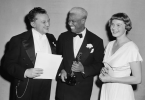
James Baskett at the Oscars on March 20, 1948, flanked by Jean Hersholt and Ingrid Bergman. Less than four months later, he would die of a heart attack.

:(
 
Back
Top