
Install the app
How to install the app on iOS
Follow along with the video below to see how to install our site as a web app on your home screen.
Note: This feature may not be available in some browsers.
You are using an out of date browser. It may not display this or other websites correctly.
You should upgrade or use an alternative browser.
You should upgrade or use an alternative browser.
Great Record Labels: Deutsche Grammophon
- Thread starter Ojai Sam
- Start date


axolotl
Nunquam non paratus
^ Oh! A tulip crown over the DGG logo cartouche. Swoon!
Are there also tulips around the rim of the record label?

 artsandculture.google.com
Are there also tulips around the rim of the record label?
The History of DG Logos - Google Arts & Culture
The Evolution of Deutsche Grammophon’s visual identity
artsandculture.google.com

Ojai Sam
Staff member
Wow! Great information I never knew.^ Oh! A tulip crown over the DGG logo cartouche. Swoon!
Are there also tulips around the rim of the record label?
The History of DG Logos - Google Arts & Culture
The Evolution of Deutsche Grammophon’s visual identity

I’ll have the answer and a related surprise for you tomorrow.

axolotl
Nunquam non paratus
Wow! Great information I never knew.
I’ll have the answer and a related surprise for you tomorrow.
Color me surprised!
Ojai Sam
Staff member
^ Oh! A tulip crown over the DGG logo cartouche. Swoon!
Are there also tulips around the rim of the record label?
The History of DG Logos - Google Arts & Culture
The Evolution of Deutsche Grammophon’s visual identity


Busy day at work, so I had to cheat and use Discogs' scans. Look at them tulips!

I'll have the surprise tomorrow or Saturday.

As Axo's article points out, the tulips appear stationary when playing the record.

axolotl
Nunquam non paratus
Busy day at work, so I had to cheat and use Discogs' scans. Look at them tulips!
I'll have the surprise tomorrow or Saturday.
As Axo's article points out, the tulips appear stationary when playing the record.
Audiophiles drool over the tulip-laden vinyl versions depicted above.
Figuratively, of course.

Nickyboy
Staff member
A zoetrope is in the works!! Dancing tulips!!
Busy day at work, so I had to cheat and use Discogs' scans. Look at them tulips!
I'll have the surprise tomorrow or Saturday.
As Axo's article points out, the tulips appear stationary when playing the record.
Ojai Sam
Staff member

Year founded: 1898
Founder: Emile Berliner
Still Active: Yes
Website: https://www.deutschegrammophon.com/en
Genres: Classical, Avant Garde
Format: LP, CD, download
Artists: Herbert von Karajan, Daniel Barenboim, Dietrich Fischer-Dieskau, Amadeus Quartet, Anne-Sophie Mutter and countless more
DG has been the ultimate classical record company since the 19th century. Over the decades, virtually every significant conductor and performer has appeared on the familiar yellow label. The silver Archiv Produktion label was launched in 1947 to release Renaissance, Baroque and other early musics. The history of Deutsche Grammophon was inextricably linked to that of Germany itself, with the resulting dark period during World War II reflecting the era's cultural imperialism. Happily, the post war years brought increased artistic and economic success with a torrent of outstanding and diverse reissues and new music within the classical realm. Today it is part of the vast Universal Music Group, thereby embracing the latest in digital technology.
Ojai Sam
Staff member
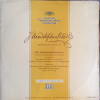
Berlin Philharmonic (Ferenc Fricsay, cond.), Rita Streich, Diana Eustrati - Mendelssohn: A Midsummer Night's Dream (rec. 1950, rel. 1952)
View album 30
Figuring out how to approach a label with 124 years' worth of history is a daunting task. Since I don't have the depth of knowledge to present an artistic analysis, I'll try to digest the DG feast from the perspective of a record collector.
Here we have the very first 12-inch LP on Deutsche Grammophon, inaugurating the famous 18000 series. Despite its sonic patina, I have uploaded my rip and scans of this album for the enjoyment of registered members only. The above cover is from Discogs since my 600 dpi scans are too large to post.
Physically, this is a very impressive package. The disc itself is quite heavy, and it came in a gatefold with liner notes on the back and a mini-catalog on the inside left. The inner sleeve is attached to the gatefold on the right. My copy was purchased in Antwerp.
The performers and performance selected here are both very interesting, politically as well as artistically. The Berlin Phil is in fine form on this 1950 recording, delivering Mendelssohn's sparkling overture and incidental music with gusto. If I weren't already married to Mrs. Ojai, their emotional reading of the Wedding March would have impelled me to run out and get hitched without delay, assuming I could find a willing victim.
Mendelssohn's Jewish background caused his music to be banished by Hitler and his cultural henchmen in favor of Wagner, Beethoven and a host of latter day mediocrities. So his appearance here is a clear gesture toward the new Germany.
Hungarian conductor Ferenc Fricsay didn't head the Berlin Phil at the time. However, after the fall of the Reich, his anti-Nazi cred did earn him the podium at both the Deutsche Oper Berlin and the RIAS Orchestra ("Rundfunk im amerikanischen Sektor", i.e. "Radio In the American Sector Symphony Orchestra"). The big guns of the baton such as Wilhelm Furtwangler and Karl Bohm were still stuck on the sidelines being denazified.
Vocalists Rita Streich and Diana Eustrati appear delightfully here as the two elves. Soprano Streich had actually been born in the U.S.S.R. after World War I to a German POW father and Russian mother. Eustrati was Greek, spending World War II in Athens at the Royal Opera House.
Taken as a whole, this remarkable album foreshadowed the greatness of the long running series of releases that it launched, while also reflecting the political realities of the day.
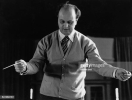
Ferenc Fricsay

Rita Streich

Diana Eustrati
View album 30
Figuring out how to approach a label with 124 years' worth of history is a daunting task. Since I don't have the depth of knowledge to present an artistic analysis, I'll try to digest the DG feast from the perspective of a record collector.
Here we have the very first 12-inch LP on Deutsche Grammophon, inaugurating the famous 18000 series. Despite its sonic patina, I have uploaded my rip and scans of this album for the enjoyment of registered members only. The above cover is from Discogs since my 600 dpi scans are too large to post.
Physically, this is a very impressive package. The disc itself is quite heavy, and it came in a gatefold with liner notes on the back and a mini-catalog on the inside left. The inner sleeve is attached to the gatefold on the right. My copy was purchased in Antwerp.
The performers and performance selected here are both very interesting, politically as well as artistically. The Berlin Phil is in fine form on this 1950 recording, delivering Mendelssohn's sparkling overture and incidental music with gusto. If I weren't already married to Mrs. Ojai, their emotional reading of the Wedding March would have impelled me to run out and get hitched without delay, assuming I could find a willing victim.
Mendelssohn's Jewish background caused his music to be banished by Hitler and his cultural henchmen in favor of Wagner, Beethoven and a host of latter day mediocrities. So his appearance here is a clear gesture toward the new Germany.
Hungarian conductor Ferenc Fricsay didn't head the Berlin Phil at the time. However, after the fall of the Reich, his anti-Nazi cred did earn him the podium at both the Deutsche Oper Berlin and the RIAS Orchestra ("Rundfunk im amerikanischen Sektor", i.e. "Radio In the American Sector Symphony Orchestra"). The big guns of the baton such as Wilhelm Furtwangler and Karl Bohm were still stuck on the sidelines being denazified.
Vocalists Rita Streich and Diana Eustrati appear delightfully here as the two elves. Soprano Streich had actually been born in the U.S.S.R. after World War I to a German POW father and Russian mother. Eustrati was Greek, spending World War II in Athens at the Royal Opera House.
Taken as a whole, this remarkable album foreshadowed the greatness of the long running series of releases that it launched, while also reflecting the political realities of the day.
Ferenc Fricsay
Rita Streich
Diana Eustrati
axolotl
Nunquam non paratus
May I signal surprise, enthusiasm, or elation now?
P. S. I am just requesting a visual cue from our great conductor.
ETA:
P. S. I am just requesting a visual cue from our great conductor.
ETA:
I saw Shakespeare's A Midsummer Night's Dream performed in Griffith Park about four years ago. Even without Mendelssohn's music, it is a great deal of fun.

 www.dailynews.com
Shakespeare’s ‘Midsummer Night’s Dream’ in Griffith Park is a joyful evening out
It’s a fun, lighthearted play to watch and, not to mention, a hard play to kill, and thus perfect for summertime entertainment.
www.dailynews.com
Last edited:
Ojai Sam
Staff member
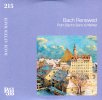
Various Artists - Bach Renewed (2018)
As a part of UMG, Deutsche Grammophon has the resources to do whatever it wants. One result has been a series of massive boxes, each devoted to presenting the complete works of an essential composer. In 2018 for Johann Sebastian's 333rd birthday, DG released "Bach 333: The New Complete Edition", a 222 disc set. Naturally such an important project has its own website:
 www.bach333.com

By the numbers, we get:
16926 Minutes (i.e. 11 days)
5533 Tracks
742 Artists
32 Labels
10 Hours of new recordings
6 track listing books
2 hardcover books ("Life" and "Music")
The press release adds helpfully that the set "weighs a whopping 13.5 kilos (about twice as heavy as a bowling ball)." For its target audience, I probably would have said that it weighs as much as a case of Dom Perignon, but you get the idea.
The press release adds:
"Never before have so many artists and record labels come together in one collection. There are 750 hand-picked performers and ensembles including acclaimed Bach interpreters Sir John Eliot Gardiner, Masaaki Suzuki, Ton Koopman, Gustav Leonhardt and Nicolaus Harnoncourt. There are historically-informed performances from Christopher Hogwood, Reinhard Goebel, Paul McCreesh, Franz Brüggen, Trevor Pinnock, Christophe Rousset and Rinaldo Alessandrini, plus there are over 50 CDs of alternative recordings including modern piano performances from András Schiff, Murray Perahia, Angela Hewitt, Martha Argerich, Alfred Brendel and many more.
90 years of evolving Bach performance traditions in vocal and instrumental practice can be heard in legendary performances from a plethora of artists from Alfred Deller to Claudio Abbado, Willem Mengelberg to Karl Richter, Edwin Fischer to Glenn Gould, Pablo Casals to Pierre Fournier, Arthur Grumiaux to Anne-Sophie Mutter. There are also more than 20 historical organs featured in the set!"
The compliers were not satisfied with merely presenting a single version each of Papa Bach's innumerable works. We get multiple versions, everything from period instrumentation to legendary performances. But wait, there's more. The last couple of dozen discs add some new compilations, tracing the composer's roots, successors and reinterpreters right into the 21st Century.
One could spend a lifetime and barely scratch the surface of this incredible resource. Rather than work chronologically I decided to begin at Disc 215, Bach Renewed. This fascinating compilation shows how eight later composers, each legendary in his own right, created new works based directly on Bach. From two of his sons to Mozart to Beethoven to Mendelssohn, we can see the torch being passed forward across the centuries. I was unaware that Mahler had even composed a "Suite For Orchestra" based on two of Bach's "Orchestral Suites". The version here recorded in 2000 by the Concertgebouw Orchestra under the baton of Riccardo Chailly is revelatory.
Based on my past performance here at MG, don't hold your breath for me to finish this collection in your lifetime (or even mine). But Bach 333 surely proves beyond a doubt that DG will remain the preeminent classical label for the foreseeable future.
As a part of UMG, Deutsche Grammophon has the resources to do whatever it wants. One result has been a series of massive boxes, each devoted to presenting the complete works of an essential composer. In 2018 for Johann Sebastian's 333rd birthday, DG released "Bach 333: The New Complete Edition", a 222 disc set. Naturally such an important project has its own website:
Deutsche Grammophon catalogue
Search the extensive catalogue of all Deutsche Grammophon artists. Search now.
By the numbers, we get:
16926 Minutes (i.e. 11 days)
5533 Tracks
742 Artists
32 Labels
10 Hours of new recordings
6 track listing books
2 hardcover books ("Life" and "Music")
The press release adds helpfully that the set "weighs a whopping 13.5 kilos (about twice as heavy as a bowling ball)." For its target audience, I probably would have said that it weighs as much as a case of Dom Perignon, but you get the idea.
The press release adds:
"Never before have so many artists and record labels come together in one collection. There are 750 hand-picked performers and ensembles including acclaimed Bach interpreters Sir John Eliot Gardiner, Masaaki Suzuki, Ton Koopman, Gustav Leonhardt and Nicolaus Harnoncourt. There are historically-informed performances from Christopher Hogwood, Reinhard Goebel, Paul McCreesh, Franz Brüggen, Trevor Pinnock, Christophe Rousset and Rinaldo Alessandrini, plus there are over 50 CDs of alternative recordings including modern piano performances from András Schiff, Murray Perahia, Angela Hewitt, Martha Argerich, Alfred Brendel and many more.
90 years of evolving Bach performance traditions in vocal and instrumental practice can be heard in legendary performances from a plethora of artists from Alfred Deller to Claudio Abbado, Willem Mengelberg to Karl Richter, Edwin Fischer to Glenn Gould, Pablo Casals to Pierre Fournier, Arthur Grumiaux to Anne-Sophie Mutter. There are also more than 20 historical organs featured in the set!"
The compliers were not satisfied with merely presenting a single version each of Papa Bach's innumerable works. We get multiple versions, everything from period instrumentation to legendary performances. But wait, there's more. The last couple of dozen discs add some new compilations, tracing the composer's roots, successors and reinterpreters right into the 21st Century.
One could spend a lifetime and barely scratch the surface of this incredible resource. Rather than work chronologically I decided to begin at Disc 215, Bach Renewed. This fascinating compilation shows how eight later composers, each legendary in his own right, created new works based directly on Bach. From two of his sons to Mozart to Beethoven to Mendelssohn, we can see the torch being passed forward across the centuries. I was unaware that Mahler had even composed a "Suite For Orchestra" based on two of Bach's "Orchestral Suites". The version here recorded in 2000 by the Concertgebouw Orchestra under the baton of Riccardo Chailly is revelatory.
Based on my past performance here at MG, don't hold your breath for me to finish this collection in your lifetime (or even mine). But Bach 333 surely proves beyond a doubt that DG will remain the preeminent classical label for the foreseeable future.
Ojai Sam
Staff member
Various Artists: DG 120: The Golden Age Of Shellac (2018)

In 2018, Deutsche Grammophon released a slew of compilations to celebrate its 120th anniversary, including a massive 121-disc box. The quality and depth of the repertoire is unarguable, but diving back into the years 1927-1943 covered here created a dilemma for the compilers. A lot of ghastly things happened inThe Third Reich Germany during these years that make this music seem a bit irrelevant. Worse, many of DG's leading artists had cozy relationships with the Nazi regime.
In an attempt to sidestep this ticklish issue, DG added tracks by comedian Otto Reutter (who died conveniently in 1931), pop singer Lale Andersen (of "Lili Marlene" fame) and Louis Armstrong. No, Satch didn't take on a Telemann "Trumpet Concerto", he happened to record a few stray jazz sides in Paris in 1934 that wound up on Polydor, a DG affiliated label. To my mind this is highly disingenuous, given the shameful treatment of Jesse Owens two years later at the Olympics in Berlin, not to mention Hitler's well-known hatred for jazz. I searched the booklet in vain for any mention of WWII at all.
 on the Sam-O-Meter. Take your revisionist history elsewhere.

In 2018, Deutsche Grammophon released a slew of compilations to celebrate its 120th anniversary, including a massive 121-disc box. The quality and depth of the repertoire is unarguable, but diving back into the years 1927-1943 covered here created a dilemma for the compilers. A lot of ghastly things happened in
In an attempt to sidestep this ticklish issue, DG added tracks by comedian Otto Reutter (who died conveniently in 1931), pop singer Lale Andersen (of "Lili Marlene" fame) and Louis Armstrong. No, Satch didn't take on a Telemann "Trumpet Concerto", he happened to record a few stray jazz sides in Paris in 1934 that wound up on Polydor, a DG affiliated label. To my mind this is highly disingenuous, given the shameful treatment of Jesse Owens two years later at the Olympics in Berlin, not to mention Hitler's well-known hatred for jazz. I searched the booklet in vain for any mention of WWII at all.
on the Sam-O-Meter. Take your revisionist history elsewhere.
Last edited:
Ojai Sam
Staff member
Albrecht Mayer - Lost and Found (2014)
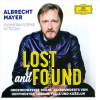
This album features Albrecht Mayer doubling on oboe and English horn while conducting the Potsdam Chamber Academy in a program of four rarely heard 18th Century composers. While all were Central European contemporaries of Mozart, Franz Anton Hoffmeister, Ludwig August Lebrun, Joseph Fiala and Jan Antonin Kozeluh each struck out in their own direction. Albrecht Mayer lends his usual brilliance to make these wind concertos come alive so successfully that the listener is left wondering how any of them ever got "lost" in the first place.
This album features Albrecht Mayer doubling on oboe and English horn while conducting the Potsdam Chamber Academy in a program of four rarely heard 18th Century composers. While all were Central European contemporaries of Mozart, Franz Anton Hoffmeister, Ludwig August Lebrun, Joseph Fiala and Jan Antonin Kozeluh each struck out in their own direction. Albrecht Mayer lends his usual brilliance to make these wind concertos come alive so successfully that the listener is left wondering how any of them ever got "lost" in the first place.
Ojai Sam
Staff member
Collegium Vocale Koln - Stockhausen: Stimmung Fur 6 Vokalisten (1970)

Vinyl Spin of the Day.

The groundbreaking DG Avant Garde series consisted of 24 albums released between 1968 and 1971, recently reissued in a 21-CD box set. The revolutionary works of cutting edge composers like Mauricio Kagel, Witold Lutoslawski, John Cage and Heinz Holliger were given a rare exposure to the broader public on a major label. Without question, Karlheinz Stockhausen was among the most important of them, but his estate blocked three of his works from inclusion in the box, including Stimmung.
That's a real shame. This acapella work is improvised by the vocalists, with one ("the model singer") singing a "magic name" which is repeated periodically by the others until the model singer "relinquishes the lead to another singer when he senses that that right moment has come." If this sounds unusual, it is, although it does sound a bit like the ululations of Central Asian vocal music.
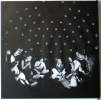
Stockhausen describes this piece as "meditative", but he did admit that the live performance at the 1969 Holland Festival was "ill fated". It seems that a dozen "Provos" (or "so-called 'radical-leftist students'" as he described them) interrupted the performance with raucous "miaow-miaow's" because they were denied the opportunity to jump on stage and join in. By their lights, this rendered the music "authoritarian".
The unedited recording on this album captured a single 73 minute rendition, sung without interruption in total darkness. Even by the standards of the Avant Garde series, it is a work of startling originality, both conceptually and performatively.
Vinyl Spin of the Day.
The groundbreaking DG Avant Garde series consisted of 24 albums released between 1968 and 1971, recently reissued in a 21-CD box set. The revolutionary works of cutting edge composers like Mauricio Kagel, Witold Lutoslawski, John Cage and Heinz Holliger were given a rare exposure to the broader public on a major label. Without question, Karlheinz Stockhausen was among the most important of them, but his estate blocked three of his works from inclusion in the box, including Stimmung.
That's a real shame. This acapella work is improvised by the vocalists, with one ("the model singer") singing a "magic name" which is repeated periodically by the others until the model singer "relinquishes the lead to another singer when he senses that that right moment has come." If this sounds unusual, it is, although it does sound a bit like the ululations of Central Asian vocal music.
Stockhausen describes this piece as "meditative", but he did admit that the live performance at the 1969 Holland Festival was "ill fated". It seems that a dozen "Provos" (or "so-called 'radical-leftist students'" as he described them) interrupted the performance with raucous "miaow-miaow's" because they were denied the opportunity to jump on stage and join in. By their lights, this rendered the music "authoritarian".
The unedited recording on this album captured a single 73 minute rendition, sung without interruption in total darkness. Even by the standards of the Avant Garde series, it is a work of startling originality, both conceptually and performatively.
axolotl
Nunquam non paratus
I have two CDs with Tuvan throat-singing. Do I need more?If this sounds unusual, it is, although it does sound a bit like the ululations of Central Asian vocal music.
Dammit. When will anarchy understand its own limits?Stockhausen describes this piece as "meditative", but he did admit that the live performance at the 1969 Holland Festival was "ill fated". It seems that a dozen "Provos" (or "so-called 'radical-leftist students'" as he described them) interrupted the performance with raucous "miaow-miaow's" because they were denied the opportunity to jump on stage and join in. By their lights, this rendered the music "authoritarian".

Unsomnambulist
Staff member
Bill Maher, that you?Dammit. When will anarchy understand its own limits?
axolotl
Nunquam non paratus
I would rather sit through a 73 minute rendition of Stimmung than a 15-minute monologue of BM.Bill Maher, that you?
Ojai Sam
Staff member
Hiroshi Wakasugi - Toru Takemitsu: Miniatur-Art (1971)
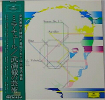
Deutsche Grammophon knows no boundaries when it comes to finding adventurous classical music. From Japan, they presented the avant garde works of composer Toru Takemitsu (1930-1996).
Calcutta Records explains:

"Miniatur – Art brings together the visionary compositions of Toru Takemitsu, one of the most influential voices in twentieth-century music, with the nuanced direction of conductor Hiroshi Wakasugi. This album invites listeners into a world where Western classical tradition meets Japanese sensibility, distilled into brief, evocative pieces that reward deep listening. Takemitsu’s miniatures are not merely short works—they are meticulously crafted sonic haikus, each containing a universe of color and texture. Wakasugi’s interpretation reveals the subtle interplay of silence and sound, space and resonance, that defines Takemitsu’s artistry. For collectors and audiophiles, this recording stands as a testament to the enduring power of restraint and innovation, offering a fresh perspective on the possibilities of orchestral timbre. Whether you are a devotee of avant-garde composition or newly curious about Takemitsu’s unique approach, Miniatur – Art provides a rare opportunity to experience music that is both intellectually stimulating and emotionally stirring. This pressing is essential for anyone eager to explore the crossroads of East and West in modern classical music, and for those who value the understated beauty of musical miniatures."
The DG Avant Garde series from the same time period featured European composers who often confronted the listener with aggressively dissonant electronica and anguished voices that can, at times, be hard to listen to. Conversely, these four short instrumental pieces feature flute, lute and guitar in very sparse, minimalist arrangements whose very subtlety compels the listener to pay attention.
Conductor Hiroshi Wakasugi (1935-2009) painted on a broad canvas. Apart from modernists like Takemitsu, he was renowned for his performances of European stalwarts like Wagner and Richard Strauss. Wakasugi led many international orchestras from Boston to Zurich and founded the Tokyo Chamber Opera Theatre.
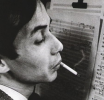
Takemitsu
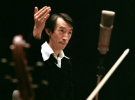
Wakasugi
Deutsche Grammophon knows no boundaries when it comes to finding adventurous classical music. From Japan, they presented the avant garde works of composer Toru Takemitsu (1930-1996).
Calcutta Records explains:
"Miniatur – Art brings together the visionary compositions of Toru Takemitsu, one of the most influential voices in twentieth-century music, with the nuanced direction of conductor Hiroshi Wakasugi. This album invites listeners into a world where Western classical tradition meets Japanese sensibility, distilled into brief, evocative pieces that reward deep listening. Takemitsu’s miniatures are not merely short works—they are meticulously crafted sonic haikus, each containing a universe of color and texture. Wakasugi’s interpretation reveals the subtle interplay of silence and sound, space and resonance, that defines Takemitsu’s artistry. For collectors and audiophiles, this recording stands as a testament to the enduring power of restraint and innovation, offering a fresh perspective on the possibilities of orchestral timbre. Whether you are a devotee of avant-garde composition or newly curious about Takemitsu’s unique approach, Miniatur – Art provides a rare opportunity to experience music that is both intellectually stimulating and emotionally stirring. This pressing is essential for anyone eager to explore the crossroads of East and West in modern classical music, and for those who value the understated beauty of musical miniatures."
The DG Avant Garde series from the same time period featured European composers who often confronted the listener with aggressively dissonant electronica and anguished voices that can, at times, be hard to listen to. Conversely, these four short instrumental pieces feature flute, lute and guitar in very sparse, minimalist arrangements whose very subtlety compels the listener to pay attention.
Conductor Hiroshi Wakasugi (1935-2009) painted on a broad canvas. Apart from modernists like Takemitsu, he was renowned for his performances of European stalwarts like Wagner and Richard Strauss. Wakasugi led many international orchestras from Boston to Zurich and founded the Tokyo Chamber Opera Theatre.
Takemitsu
Wakasugi
Last edited:

Zeeba Neighba
Staff member
Great series
I often scan Spotify's "New Classical Releases" and gravitate to the new DG releases - there may be other "better" recordings of certain pieces out there but you really can in general trust DG artistic choices and quality
I often scan Spotify's "New Classical Releases" and gravitate to the new DG releases - there may be other "better" recordings of certain pieces out there but you really can in general trust DG artistic choices and quality


