
Install the app
How to install the app on iOS
Follow along with the video below to see how to install our site as a web app on your home screen.
Note: This feature may not be available in some browsers.
You are using an out of date browser. It may not display this or other websites correctly.
You should upgrade or use an alternative browser.
You should upgrade or use an alternative browser.
What Are You Listening to? September, 2021
- Thread starter Nickyboy
- Start date
- Status
- Not open for further replies.


axolotl
Nunquam non paratus
Ralph Vaughan Williams ~ Symphony No. 4; Symphony No. 6 (New Philharmonia Orchestra; Sir Adrian Boult) (1991)

Two symphonies from RVW that I have enjoyed for decades. Symphony #4 was written between 1931 and 1934. From the liner notes on EMI Classics,
This Epilogue is one of my favorite passages of music.
You are welcome.
Two symphonies from RVW that I have enjoyed for decades. Symphony #4 was written between 1931 and 1934. From the liner notes on EMI Classics,
It was perhaps inevitable that, because of the violent nature of much of the Fourth Symphony, it should also be labelled as a prophetic warning of the consequences of totalitarianism. Vaughan Williams himself denied any such intent; he wrote to a friend in 1937: "I wrote it not as a definite picture of anything external - e.g., the state of Europe - but simply because it occurred to me like this... It is what I wanted to do at the time." Hence his often quoted remark at the early rehearsals, "I don't know if I like it, but it is what I meant."
Vaughan Williams began his Sixth Symphony in 1944, when he was approaching 72, and completed it in 1947... In 1948, when the Second World War was fresh in the mind and the possibility of another seemed to be hardening into probability, this symphony seemed to reflect the temper of the age or to be a prophecy. One sympathetic commentator labelled it 'the War Symphony', only to be severely rebuked by the composer for implying the existence of a 'programme', which he emphatically denied. Speculation was particularly intense about the strange pianissimo Epilogue, which many people heard as a musical depiction of a world laid waste by atomic warfare. In a letter dated 22 January 1956 to the present writer, Vaughan Williams said: "With regard to the last movement of my no. 6, I do not believe in meanings and mottoes, as you know, but I think we can get in words nearest to the substance of my last movement in, "We are such stuff as dreams are made on, and our little life is rounded with a sleep." These line from Prospero's Farewell in Shakespeare's Tempest are the correct clue to the whole work's emotional climate. The storms of life, of which war is but one, end in the greatest mystery of all, the nature of that eternal 'sleep' which rounds it off.
This Epilogue is one of my favorite passages of music.
You are welcome.
Last edited:

Ojai Sam
Staff member
Very profound. I’m going to have to track this one down.Ralph Vaughan Williams ~ Symphony No. 4; Symphony No. 6 (New Philharmonia Orchestra; Sir Adrian Boult) (1991)
Two symphonies from RVW that I have enjoyed for decades. Symphony #4 was written between 1931 and 1934. From the liner notes on EMI Classics,
This Epilogue is one of my favorite passages of music.
You are welcome.
Who knew that Vaughan Williams was such a large influence on American popular music?


Unsomnambulist
Staff member
Alrune Rod - Alrune Rock (1973)





Ojai Sam
Staff member
Yes, they are terrific. Rhino Handmade did an eye opening box set.Fanny, the "Queens of Rock and Roll"
Who was Fanny? The band you never heard of (except for Ojai, probably! ).
Unsomnambulist
Staff member
Fanny, the "Queens of Rock and Roll"
Who was Fanny? The band you never heard of (except for Ojai, probably! ).
I bet they were very popular in England.
axolotl
Nunquam non paratus
You mentioned Symphony No. 9.New York Philharmonic (Leopold Stokowski) - Vaughan Williams: Symphony No. 9 (1949)
View attachment 6459
This is the 1949 world premiere performance. That last movement is very disquieting. If at some level it represents eternal sleep, we are in for a restless eternity.
View attachment 6460
That's a good one, too.
As Jimi wrote:
"Now if a 6 turned out to be 9
I don't mind, I don't mind, (well alright)
If all the hippies cut off all their hair
I don't care, I don't care
Dig, cause I got my own world to live through
And uh, and I ain't going to copy you"
Ojai Sam
Staff member
I meant 6. Must be upside down dyslexic.You mentioned Symphony No. 9.
That's a good one, too.
As Jimi wrote:
"Now if a 6 turned out to be 9
I don't mind, I don't mind, (well alright)
If all the hippies cut off all their hair
I don't care, I don't care
Dig, cause I got my own world to live through
And uh, and I ain't going to copy you"

lpfreak1170
Well-Known Member
No Thanks! The '70s Rebellion (4 CD box set)

Classic box!
Ojai Sam
Staff member
Woody Herman - 1940 (Classics comp 2002)

Today,, Woody is recalled as mentor to many leading jazz players. But during the big band era, he led one of the most popular dance bands and was himself a crooner of no little skill. His popularity is demonstrated by the fact that Decca had him record five sessions between February and September. Woody sang on more than half of these sides.
Today,, Woody is recalled as mentor to many leading jazz players. But during the big band era, he led one of the most popular dance bands and was himself a crooner of no little skill. His popularity is demonstrated by the fact that Decca had him record five sessions between February and September. Woody sang on more than half of these sides.

Zeeba Neighba
Staff member
Suede - Suede (1993)

A little break from Broadway listening. Was sitting at lunch today, and, for unclear reasons, "Animal Nitrate" got stuck in my head.
A little break from Broadway listening. Was sitting at lunch today, and, for unclear reasons, "Animal Nitrate" got stuck in my head.
axolotl
Nunquam non paratus
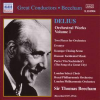
Royal Philharmonic/London Philharmonic (Sir Thomas Beecham) - Delius: Orchestral Works vol. 1 (rec. 1927-34, Naxos Historical 2000)
View attachment 6463
I saw this, and I just couldn't Delius any longer.
So, I broke this out:
Frederick Delius ~ Orchestral Works (Sir Colin Davis / BBC Symphony Orchestra) (2002, 1992)
There's nothing I like more on hearing the first cuckoo in spring than spending a summer night on the river.
Ojai Sam
Staff member
Here's your Delius trivia for the day:I saw this, and I just couldn't Delius any longer.
So, I broke this out:
Frederick Delius ~ Orchestral Works (Sir Colin Davis / BBC Symphony Orchestra) (2002, 1992)
There's nothing I like more on hearing the first cuckoo in spring than spending a summer night on the river.
Fritz Delius changed his name to "Frederick" in 1902. He is also rumored to have fathered a son while living in Florida. The mother was an African-American woman named Chloe.
axolotl
Nunquam non paratus
Here's your Delius trivia for the day:
Fritz Delius changed his name to "Frederick" in 1902. He is also rumored to have fathered a son while living in Florida. The mother was an African-American woman named Chloe.
I just read through an article entitled Delius and Neurosyphilis that semi-confirms this account.
Hmm... this gives "a summer night on the river" new meaning.
- Status
- Not open for further replies.
Similar threads


- Replies
- 103
- Views
- 6K

- Replies
- 91
- Views
- 838

- Replies
- 73
- Views
- 1K
- Replies
- 81
- Views
- 2K